
CONTRIBUTORS

Sonal Desai, Ph.D.
Chief Investment Officer,
Franklin Fixed Income
The US Federal Reserve’s decision to keep interest rates steady at its March meeting came as little surprise, but its updated “dot plot” projections were interpreted by markets as sending a decidedly more dovish signal than expected. Franklin Templeton Fixed Income Group CIO Sonal Desai offers her take on the meeting, and why she feels markets shouldn’t read too much into the dots.
I’m surprised at how surprised—and frothy—market reaction has been at the outcome of the Federal Reserve’s (Fed) March policy meeting. My reading is that the Fed confirmed the patient tone it already adopted in January, and for the same reasons, but the Fed remains data-dependent and investors should focus on the economic outlook, not on the dots.
Fed policymakers pointed to the soft tone of first-quarter economic indicators, but the first quarter has typically had a seasonally soft bias. This justifies caution, but I don’t view it as a sign of a significantly weaker outlook.
Moreover, Fed Chairman Jay Powell’s tone in the Q&A session following the announcement was nowhere near as dovish as the immediate market reaction would suggest.
Don’t Depend On The Dots
Markets saw the change in the “dot plot” as an important dovish surprise. The dots now show no more interest-rate hikes in 2019 and just one hike in 2020, whereas in December they reflected two rate hikes this year.
It’s important to understand, however, that the dot plot does not represent the collective, consensus view of the Federal Open Market Committee (FOMC), the Fed’s decision-making body. The dots simply represent the views of each individual FOMC member as to where the policy rate will likely be in each year. The dot plot has changed quite dramatically within three months in the past, and can easily do so again.
Indeed, Powell has been trying to de-emphasize the importance of the dots, because the Fed has abandoned its formal forward guidance and now wants to maintain flexibility to react to economic conditions. He specifically indicated the markets should not take the dots as a substitute for the forward guidance that the Fed has chosen to abandon, most recently in a speech at Stanford University. He repeated that message at the March policy meeting, but markets seem to have completely ignored it.
In fact, markets have gone even further: Fed funds futures show that 40% of investors now expect rate cuts already this year1, while the new Fed dots envision one more rate hike—albeit only next year—and then rates on hold through 2021.
Most importantly, the Fed has indicated clearly its policy will be data-dependent, and I continue to expect the data will warrant higher rates.
US Interest Rate Expectations
Fed Dot Plot vs Futures Curve
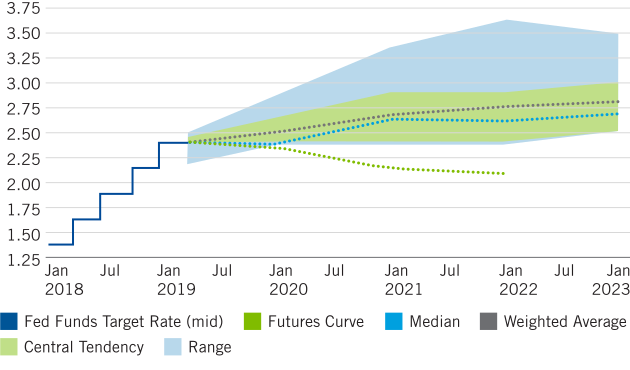
Sources: Franklin Templeton Capital Market Insights Group, Macrobond, CME Group, Federal Reserve. OIS (overnight index swap)/market consensus. Participants’ projections of the appropriate level of the target federal funds rate (rounded to the nearest 1/8 percentage point) at the end of the specified calendar year. Participants’ projections are summarized in the form of a median, weighted average, central tendency, and range, The central tendency is the range of participant projections, excluding the three highest and three lowest projections for each year. The straight lines between each calendar year-end projection are based on a simple linear interpolation. There is no assurance that any projection, estimate or forecast will be realized. For illustrative purposes only.
US Economic Projections
Media headlines have emphasized the downward revisions in the Fed’s monetary policy and economic forecasts, but these amounted to just marginal changes:
- The Fed lowered its 2019 US growth forecast to 2.1% from its prior forecast of 2.3%, and lowered its 2020 forecast to 1.9% from 2.0% prior.
- The 2019 inflation projection (based on Core Personal Consumption Expenditures) was lowered to 1.8% from 1.9%
- The projection for the unemployment rate edged up to 3.7% for 2019, from its prior projection of 3.5%
These are all marginal revisions, well within the margin of forecasting error.
Confidence In Controlling Inflation
In my view, the Fed has decided to keep interest rates on hold because it feels highly confident that once inflation starts to rise, it will be able to quickly pull it back under control. Given this, it prefers to stack the deck in favor of growth and let the economy run hot until it sees inflation move above the 2% target. The Fed is also confident that the risk of asset bubbles is limited—though there’s little doubt in my opinion that the markets are on a bit of Fed-fueled sugar high.
Trade Tensions Should Ease
The Fed reiterated that trade tensions and Brexit counsel prudence.
I think these are secondary considerations. The United States and China seem headed toward an agreement on trade in the near term. Brexit tensions have risen ahead of the March 29 deadline, but it looks like the United Kingdom will now get a 6-9 month extension, which will push the issue to the backburner as far as markets are concerned. Separately, it is difficult to imagine that markets have the ability to be further shocked by an event that they have been anticipating for almost three years now.
The main driver of Fed policy will remain the domestic economic outlook. As I noted in my February “On My Mind,” household consumption remains supported by a hot labor market and a robust balance sheet. As the global uncertainty diminishes, the US growth outlook will continue to warrant higher interest rates.
ENDNOTES
-
Source: CME Group. Fed funds futures are financial contracts representing the market’s view of where the daily official federal funds rate will be at the time of the contract expiry.