

CONTRIBUTORS

Francis Gannon
Co-Chief Investment Officer, Managing Director, Royce Investment Partners
Facing ample uncertainty, small-caps maintain leadership
Most of the world’s equity indexes began 2026 on a positive note—which went sour when the United States and Israel went to war with Iran, creating concerns for investors beyond the human costs and geopolitical instability. Prior to the onset of the conflict—which spurred a shock to global energy supplies when Iran closed off the logistically vital Strait of Hormuz—investors were facing an already-lengthy and weighty set of worries, including sticky inflation, increased unemployment, fear of a market bubble (mostly limited to large-cap stocks), a sluggish housing market, and declining consumer confidence. To this list we can add unease about private credit potentially having a bubble of its own—with ripple effects that are impossible to predict.
In light of these issues, we were pleased to see 1Q26 conclude with the small-cap Russell 2000 and Russell Microcap Indexes each surviving the wild swings that have characterized the US equity markets since the beginning of the war by eking out positive returns. 2026’s first quarter marked the fourth consecutive quarter in which the micro-cap index beat the major domestic large-cap indexes, helping solidify the market leadership for both small- and micro-cap stocks that began off the April 2025 market low.
For 1Q26, both the Russell Microcap and Russell 2000 were positive, with the Russell 2000 gaining 0.9% and the Russell Microcap advancing 1.5%. By comparison, the large-cap Russell 1000 Index declined -4.2% while the mega-cap Russell Top 50 Index fell -7.9% as the “Mag 7” turned into the “Lag 7.” The Russell 1000 has experienced 26 down quarters over the last 25 years—and the Russell 2000 has beaten its large-cap sibling only eight times (including 1Q26). Small-caps had a positive return in only one other previous down quarter for large-cap, which occurred in 2Q08 during the Great Financial Crisis.
Amid High Volatility, Small- and Micro-Cap Remained in Front
1Q26 Russell Index Performance

Source: Russell Investments. Past performance is no guarantee of future results.
Small- and micro-caps show their strength off the market low
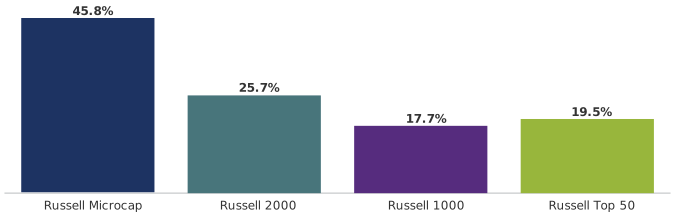
The pattern of small-cap leadership also held for the 1-year period ended 3/31/26, in which the Russell Microcap gained 45.8%, the Russell 2000 advanced 25.7%, the Russell 1000 rose 17.7%, and the Russell Top 50 increased 19.5%. The 12-month spread between the small- and micro-cap indexes was the fourth-widest since the micro-cap index’s 2000 inception. The one-year period ended 3/31/26 encompasses nearly all of the dramatic upswing off the market low on 4/8/25, a period in which the Russell Microcap gained an impressive 65.9%, and the Russell 2000 rose 43.6%.
Small- and Micro-Cap Stocks' Impressive Run
One-year Russell Index Returns ended 3/31/26
Source: Russell Investments. Past performance is no guarantee of future results.
Foreign affairs
Results for non-US stocks aligned somewhat similarly with their stateside peers in 1Q26, with non-US small-caps beating non-US large-caps. The MSCI ACWI ex-USA Small Cap Index fell -0.5% in 1Q26 while its large-cap counterpart, the MSCI ACWI ex-USA Large Cap Index, lost -1.1%.
One-year results for both asset classes were noteworthy, with non-US small-caps outpacing their large-cap counterparts. The MSCI ACWI ex-USA Small Cap advanced 27.8% in for the 1-year period ended 3/31/26 while the MSCI ACWI ex-USA Large Cap gained 24.2%.
Small-cap value stayed in the black while growth saw red
For the third consecutive quarter, the Russell 2000 Value Index beat the Russell 2000 Growth Index, up 5.0% versus a loss of -2.8% in 1Q26. Unlike small-cap value’s advantages in the last two quarters of 2025, results in the first quarter were more in line with each style index’s long-running historical patterns—small-cap growth typically outperforms in fast-growing or earnings-starved market climates while small-cap value usually outperforms in down markets or when the economy is expanding.
For the one-year period ended 3/31/26, the Russell 2000 Value advanced 28.1% versus 23.6% for the Russell 2000 Growth. As is often the case, annualized results over longer periods ended 3/31/26 were a bit more mixed in terms of style leadership. Small-cap value was ahead for the 3-year (+13.8% versus +12.3) and 5-year (+5.8% vs. +1.6%) periods, while small-cap growth had a narrow advantage for the 10-year span, rising 9.8% compared to 9.6% for the small-cap value index.
Thanks to its strong absolute and relative performance over the last nine months, small-cap value assumed leadership off the April 2025 low—from 4/8/25-3/31/26, the Russell 2000 Value gained 47.9% versus a 42.0% advance for the Russell 2000 Growth.
The small-cap sector story: Energy and industrials were positive in small-cap, tech leads in micro-cap
Four of the 11 sectors in the Russell 2000 finished 1Q26 in the black. Energy, Industrials, and Materials made the biggest positive contributions while the leading detractors were Health Care, Information Technology (a top contributor in the Russell Microcap thanks to the strength of semiconductors and semiconductor equipment), and consumer discretionary.
At the industry level, the top contributors came from energy and industrials: Oil, gas and consumable fuels, energy equipment and services, and electrical equipment. The biggest detractor was software (information technology), where many companies are struggling with the perception that AI will eventually make them obsolete. Health care equipment & supplies detracted after a strong 4Q25, due in part to investors taking gains, while professional services detracted as many corporations pared back discretionary spending in the first quarter.
Cautious in the near term, constructive on the long term
Looking at the state of play in the economy and geopolitics, we know it is easy for investors to feel discouraged or anxious. For our part, however, we have been struck by how many of the factors that can drive positive long-term returns and market leadership remain in place even in these volatile and unsettling days.
Of course, our optimism is far more measured than it was at the end of 2025. To be sure, the “Fog of War,” which refers to the difficulties and uncertainties participants experience during armed conflict, can be repurposed to remind investors that many other challenges exist behind the war-driven headlines. And just as militaries use intelligence in their attempts to pierce the fog, we use research, analysis, and conversations with management teams to uncover long-term opportunities that may not otherwise reveal themselves when much of the world’s attention is elsewhere.
The 100% depreciation on research and capital expenditure (capex), courtesy of the “Big, Beautiful Bill” signed last year, still suggests a robust capex cycle through the remainder of 2026—and previous capex cycles have generally been a positive for select small-cap stocks.
We also see an important shift in the artificial intelligence (AI) trade that offers two possible ways to reward (in some cases keep rewarding) smaller companies. First, we anticipate that more investors will recognize how many small-cap companies are critical suppliers of the AI revolution, including (but not limited to) the semiconductor component makers that enable various AI applications, energy providers crucial to the functioning of data centers, and the construction companies building them. Second are those companies that are using AI to drive innovation, automation and efficiency, which we think is a particularly promising long-term trend.
Equally important is the ongoing effect of the 2021’s Infrastructure Investment and Jobs Act (IIJA). A lot of attention has been paid to the positive effects of the “One Big Beautiful Bill” Act, but we think it’s equally important for investors to know that the United States is still in the early stages of spending from the IIJA and the associated funding of the Broadband Equity Access and Deployment Program (BEAD)—which is bolstering rural telecom infrastructure. These programs support what should be a long-term trend toward the reindustrialization of the US economy. Of the $1.2 trillion earmarked for infrastructure spending, about half is yet to be spent.
As we have noted previously, we believe active management should be key to sourcing the smaller companies that are best positioned to benefit from these developments during an otherwise shaky market environment.
What do valuations, earnings, and five-year annualized returns suggest about long-term small-cap performance?
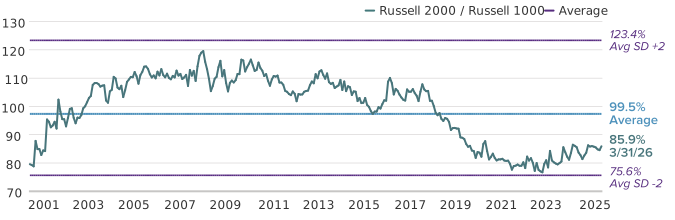
We still think the most compelling case for small-cap leadership comes from the somewhat rare and promising confluence of relatively low valuations for small-cap versus large-cap and the forecast for higher earnings for small-cap companies—with each factor not shifting very much from what we saw at the end of last year—better short-term relative returns for small-caps have not elevated their valuations to meet those of large-caps. In fact, using our preferred index valuation metric of EV/EBIT (enterprise value over earnings before interest and taxes) shows that at the end of 1Q26, valuations for the Russell 2000 still sat close to their lowest levels versus the Russell 1000 in 25 years.
Relative Valuations for Small-Caps vs. Large-Caps Remain Near Their Lowest in 25 Years
Russell 2000 vs. Russell 1000 Median LTM EV/EBIT (ex. Negative EBIT Companies), 3/31/01 through 3/31/26
Source: FactSet.
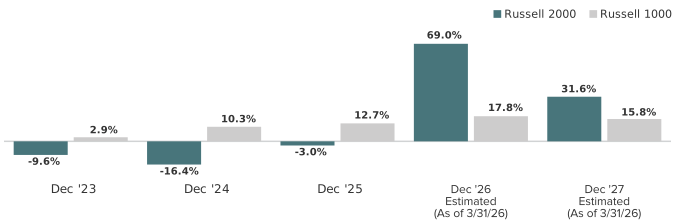
And as always, earnings are key. We have always subscribed to the adage that psychology runs the market in the short run (and 1Q26 gave us all a masterclass in that dynamic), but earnings run it in the long run. Earnings across asset classes were generally positive in 4Q25, with smaller companies generally faring best. Even more encouraging, the ongoing research we have seen forecasts better relative earnings growth for small-cap stocks in 2026.
Small-Cap’s Estimated Earnings Growth Is Expected to Remain Higher Than Large-Cap Stocks in 2026
One-Year EPS Growth
Source: FactSet. Earnings per share (EPS) is calculated as a company’s profit divided by the outstanding shares of its common stock. The EPS Growth Estimates are the pre-calculated mean two-year EPS growth rate estimates by brokerage analysts. Estimates are the average of those provided by analysts working for brokerage firms who provide research coverage on each individual security as reported by FactSet. All non-equity securities, investment companies, and companies without brokerage analyst coverage are excluded. Past performance is not guarantee of future results. There is no assurance that any estimate, forecast or projection will be realized.
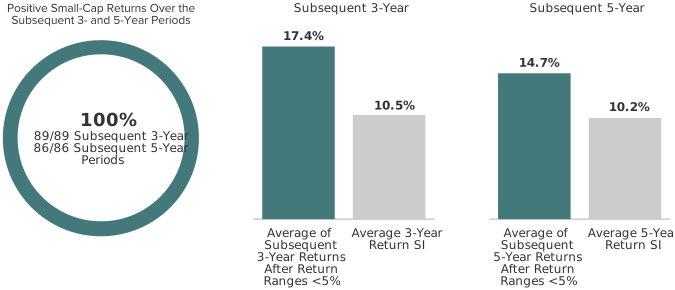
One final piece to our optimistic long-term forecast is rooted in the 3.8% average annualized return for the Russell 2000 for the five years ended 3/31/26. Since the inception of the Russell 2000 on 12/31/78, when the average annualized five-year return was 5% or less, subsequent three- and five-year returns were positive 100% of the time—and were higher than each period’s average annualized returns since inception, as seen in the chart below.
100% of the Time, Positive Three- and Five-Year Returns Have Followed Low Return Markets
Subsequent Average Annualized Three- and Five-Year Performance for the Russell 2000 Following 5-Year Annualized Return Ranges of Less Than 5%, 12/31/83-3/31/26
Source: Russell Investments. As of 3/31/26, the average of subsequent 3-year return ranges <3% has 472 periods, the average 3-year return since inception has 532 periods, the average of subsequent 5-year returns after return ranges <3% has 448 periods, the average 5-year return since inception has 508 periods. Past performance is no guarantee of future results.
Most important of all, our investment teams remain confident that small-cap can extend its nascent market leadership. We are working each day in an effort to use short-term volatility to our long-term advantage and create market-beating returns. We also want to remind investors that the opportunity still exists to build one’s small-cap allocation at attractive valuations. The current period looks to us like an especially opportune time to invest in select small-caps for the long run.
Definitions
The Russell 1000 Index is an unmanaged, capitalization-weighted index of domestic large-cap stocks. It measures the performance of the 1,000 largest publicly traded US companies in the Russell 3000 Index.
The Russell 2000 Index is an index of domestic small-cap stocks that measures the performance of the 2,000 smallest publicly traded US companies in the Russell 3000 Index.
The Russell Top 50 Index is a market-capitalization-weighted index of the 50 largest stocks in the broad-based Russell 3000 universe of US-based equities.
The Russell Microcap Index measures the performance of the microcap segment of the US equity market. Microcap stocks make up less than 3% of the US equity market (by market cap) and consist of the smallest 1,000 securities in the small-cap Russell 2000® Index, plus the next smallest eligible securities by market cap.
The Russell 2000 Value and Growth indexes consist of the respective value and growth stocks within the Russell 2000 as determined by Russell Investments.
The MSCI ACWI ex USA Small Cap Index is an unmanaged, capitalization weighted index of global small-cap stocks, excluding the United States.
The MSCI ACWI ex USA Large Cap Index is an unmanaged, capitalization weighted index of global large-cap stocks, excluding the United States.
Magnificent Seven: Refers to shares of Apple, Microsoft, Amazon, Alphabet, Meta Platforms, Nvidia, and Tesla.
Enterprise value (EV) refers to the entire value of a company after taking into account both holders of debt and equity.
The EV/EBIT multiple is the ratio between enterprise value (EV) and earnings before interest and taxes (EBIT).
Capital expenditure (capex) refers to investment spending in long-term assets (fixed assets). These expenditures include new buildings, machinery, and other equipment needed for an organization's day-to-day operations. Most companies use capex financing to fund their long-term investments.
The One Big Beautiful Bill Act of 2025 is a US federal statute passed by the 119th United States Congress containing tax and spending policies that form the core of President Donald Trump's second-term agenda. The bill was signed into law by President Trump on July 4, 2025.
The Broadband Equity, Access, and Deployment (BEAD) Program is a US federal initiative under the Infrastructure Investment and Jobs Act of 2021 designed to achieve universal, high-speed internet access.
WHAT ARE THE RISKS?
All investments involve risks, including possible loss of principal. Past performance is no guarantee of future results. Please note that an investor cannot invest directly in an index. Unmanaged index returns do not reflect any fees, expenses or sales charges.
Active management does not ensure gains or protect against market declines.
Equity securities are subject to price fluctuation and possible loss of principal.
Commodities and currencies contain heightened risk that include market, political, regulatory, and natural conditions and may not be suitable for all investors.
Small- and mid-cap stocks involve greater risks and volatility than large-cap stocks.
US Treasuries are direct debt obligations issued and backed by the “full faith and credit” of the US government. The US government guarantees the principal and interest payments on US Treasuries when the securities are held to maturity. Unlike US Treasuries, debt securities issued by the federal agencies and instrumentalities and related investments may or may not be backed by the full faith and credit of the US government. Even when the US government guarantees principal and interest payments on securities, this guarantee does not apply to losses resulting from declines in the market value of these securities.
Any companies and/or case studies referenced herein are used solely for illustrative purposes; any investment may or may not be currently held by any portfolio advised by Franklin Templeton. The information provided is not a recommendation or individual investment advice for any particular security, strategy, or investment product and is not an indication of the trading intent of any Franklin Templeton managed portfolio. Past performance does not guarantee future results.
Any data and figures quoted in this article sourced from Russell Investments, FactSet, Bloomberg and Reuters.
Important data provider notices and terms available at www.franklintempletondatasources.com. All data is subject to change.
WF: 9779559