

SEPTEMBER 17, 2026
Pacing the Frontier
Calls to "pace the frontier" mean slowing the release of powerful AI models to test and control them better, not halting development or spending.

CONTRIBUTORS

Head of Innovation
Franklin Templeton

Head of Industry Advisory Services
Franklin Templeton

Senior Analyst
Franklin Templeton

Senior Analyst
Franklin Templeton

Senior Analyst
Franklin Templeton
This first article will provide a high-level overview of the key findings, which will be followed by a series of short articles published at regular intervals over the coming weeks, unpacking those four dimensions of our industry’s future.
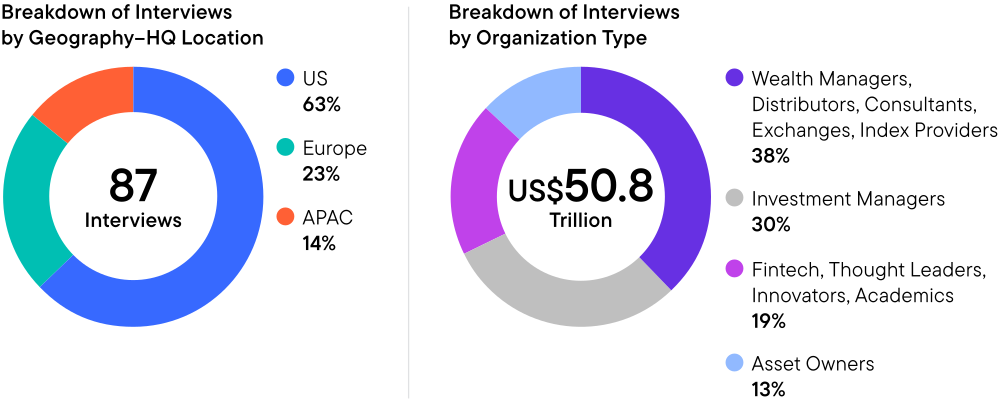
On an annual basis, Franklin Templeton’s Industry Advisory Services team conducts off-the-record, unscripted interviews of leaders across the investment management industry. This year, we were fortunate enough to hear from 87 leading thinkers controlling over US$50.8 trillion of assets under management about their views on the future of investing between March and September of 2024. Input came from a broad cross-section of the industry—asset owners, private banks, wealth managers, consultants, investment managers, crypto firms, academics, industry leaders and fintech firms. Conversations took place formally as part of free-ranging, qualitative, off-the-record, survey interviews, and informally during one-on-one sessions where the implications and plans for each organization are discussed and explored. Each of these inputs added to an emerging picture of an industry that is changing rapidly and across multiple dimensions. Interviews were conducted globally with about two-thirds of discussions held with leaders of firms based in the United States, and the other third spread between Europe and Asia.
Our intention is to summarize this wide-ranging set of inputs and present the findings back for use by the broader industry as part of a dialogue meant to help organizations think about their own future. This new “Future of Investing” survey will be released annually
All input from individuals and the firms they represent is anonymous. We do not delve into any organization’s individual plans, nor do we expose any firm’s direct strategy. Instead, we look to synthesize the comments we have heard and distill spots where there is either alignment in multiple participants’ views or there are inklings of a new and potentially disruptive path that might upend conventional thinking.
Breakdown of Interviewees by Organization Type and Location of Global Headquarters
Data as of October 2024.
This year’s Survey findings fall into four overlapping areas that will guide our presentation of them: the future of money, the future of asset management, the future portfolio and the future of advisory. This first article will provide a high-level overview of the key findings, which will be followed by a series of short articles published at regular intervals over the coming weeks, unpacking those four dimensions of our industry’s future.
While some will be keenly interested in the overall strategic themes and the interplay between their underlying dynamics, other readers will have more specific areas of interest. The forthcoming article series is deliberately written for both groups, and while the articles can be read individually or together, when read in sequence a much more important overarching story emerges.
WHAT ARE THE RISKS?
All investments involve risks, including possible loss of principal.
Companies in the technology sector have historically been volatile due to the rapid pace of product change and development within the sector. Artificial Intelligence is subject to various risks, including, potentially rapid product obsolescence, theft, loss, or destruction of cryptographic keys, the possibility that digital asset technologies may never be fully implemented, cybersecurity risk, conflicting intellectual property claims, and inconsistent and changing regulations.
Blockchain and cryptocurrency investments are subject to various risks, including inability to develop digital asset applications or to capitalize on those applications, theft, loss, or destruction of cryptographic keys, the possibility that digital asset technologies may never be fully implemented, cybersecurity risk, conflicting intellectual property claims, and inconsistent and changing regulations. Speculative trading in bitcoins and other forms of cryptocurrencies, many of which have exhibited extreme price volatility, carries significant risk; an investor can lose the entire amount of their investment. Blockchain technology is a new and relatively untested technology and may never be implemented to a scale that provides identifiable benefits. If a cryptocurrency is deemed a security, it may be deemed to violate federal securities laws. There may be a limited or no secondary market for cryptocurrencies.
Digital assets are subject to risks relating to immature and rapidly developing technology, security vulnerabilities of this technology (such as theft, loss, or destruction of cryptographic keys), conflicting intellectual property claims, credit risk of digital asset exchanges, regulatory uncertainty, high volatility in their value/price, unclear acceptance by users and global marketplaces, and manipulation or fraud. Portfolio managers, service providers to the portfolios and other market participants increasingly depend on complex information technology and communications systems to conduct business functions. These systems are subject to a number of different threats or risks that could adversely affect the portfolio and their investors, despite the efforts of the portfolio managers and service providers to adopt technologies, processes and practices intended to mitigate these risks and protect the security of their computer systems, software, networks and other technology assets, as well as the confidentiality, integrity and availability of information belonging to the portfolios and their investors.
ETFs trade like stocks, fluctuate in market value and may trade above or below the ETF’s net asset value. Brokerage commissions and ETF expenses will reduce returns. ETF shares may be bought or sold throughout the day at their market price on the exchange on which they are listed. However, there can be no guarantee that an active trading market for ETF shares will be developed or maintained or that their listing will continue or remain unchanged. While the shares of ETFs are tradable on secondary markets, they may not readily trade in all market conditions and may trade at significant discounts in periods of market stress.
This material is intended to be of general interest only and should not be construed as individual investment advice or a recommendation or solicitation to buy, sell or hold any security or to adopt any investment strategy. It does not constitute legal or tax advice. This material may not be reproduced, distributed or published without prior written permission from Franklin Templeton.
The views expressed are those of the investment manager and the comments, opinions and analyses are rendered as at publication date and may change without notice. The underlying assumptions and these views are subject to change based on market and other conditions and may differ from other portfolio managers or of the firm as a whole. The information provided in this material is not intended as a complete analysis of every material fact regarding any country, region or market. There is no assurance that any prediction, projection or forecast on the economy, stock market, bond market or the economic trends of the markets will be realized. The value of investments and the income from them can go down as well as up and you may not get back the full amount that you invested. Past performance is not necessarily indicative nor a guarantee of future performance. All investments involve risks, including possible loss of principal.
Any research and analysis contained in this material has been procured by Franklin Templeton for its own purposes and may be acted upon in that connection and, as such, is provided to you incidentally. Data from third party sources may have been used in the preparation of this material and Franklin Templeton ("FT") has not independently verified, validated or audited such data. Although information has been obtained from sources that Franklin Templeton believes to be reliable, no guarantee can be given as to its accuracy and such information may be incomplete or condensed and may be subject to change at any time without notice. The mention of any individual securities should neither constitute nor be construed as a recommendation to purchase, hold or sell any securities, and the information provided regarding such individual securities (if any) is not a sufficient basis upon which to make an investment decision. FT accepts no liability whatsoever for any loss arising from use of this information and reliance upon the comments, opinions and analyses in the material is at the sole discretion of the user.
Franklin Templeton has environmental, social and governance (ESG) capabilities; however, not all strategies or products for a strategy consider “ESG” as part of their investment process.
Products, services and information may not be available in all jurisdictions and are offered outside the U.S. by other FT affiliates and/or their distributors as local laws and regulation permits. Please consult your own financial professional or Franklin Templeton institutional contact for further information on availability of products and services in your jurisdiction.
Issued in the U.S. by Franklin Templeton, One Franklin Parkway, San Mateo, California 94403-1906, (800) DIAL BEN/342-5236, franklintempleton.com. Investments are not FDIC insured; may lose value; and are not bank guaranteed.
You need Adobe Acrobat Reader to view and print PDF documents. Download a free version from Adobe's website.
CFA® and Chartered Financial Analyst® are trademarks owned by CFA Institute.


